
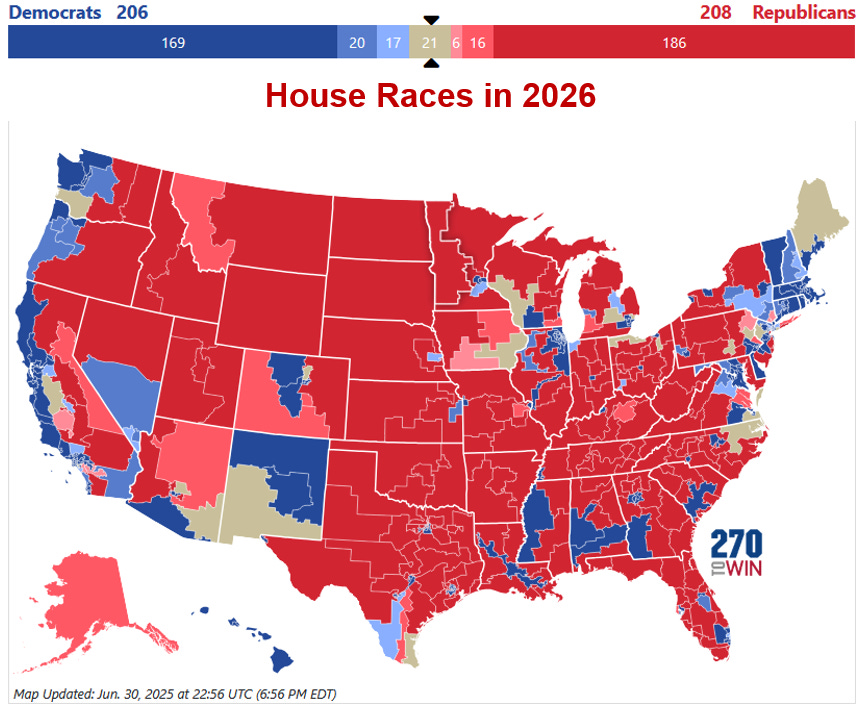
The data is converging. And for the first time since the midterm cycle began, it is converging in a direction that is unmistakable.
A PBS/NPR/Marist poll released this month shows Democrats leading the generic congressional ballot by 14 points — 55 to 41 percent — the largest advantage either party has held in this survey since 2017. Among independents, the margin is a staggering 33 points: 61 to 28 percent. An NBC News survey puts Democratic preference for congressional control at 50 to 42 percent — the widest gap since 2018. Marquette Law School polling finds that voters who are “absolutely certain” to vote prefer a Democrat by 9 points. Of the 11 most recent polls aggregated by RealClearPolitics, Democrats lead in 10; the remaining one is a tie.
President Trump’s approval rating sits at 43 percent, with 55 percent disapproving. Two-thirds of voters say the administration has fallen short on the economy, the cost of living, and looking out for the middle class. More than half say it has fallen short on foreign policy — a verdict driven overwhelmingly by the unpopular war in Iran, which has sent oil prices above $100, gasoline above $4 a gallon, and consumer confidence into a tailspin. The only issue on which the administration receives positive marks is border security, where 51 percent say Trump has met expectations.
Meanwhile, the structural indicators are flashing red for Republicans. Fifty-six House members have announced their retirement — 36 Republicans and 22 Democrats — the second-highest number in a single cycle in U.S. history, behind only 1992. Republican retirements outnumber Democratic ones nearly two to one, a ratio that historically correlates with the majority party sensing a wave it cannot stop.
Democratic enthusiasm is running ahead of Republican enthusiasm by 7 points on a 10-point interest scale — 74 percent of Democrats rate their midterm interest at 9 or 10, versus 67 percent of Republicans. In 2018, when Democrats gained 41 House seats, the enthusiasm gap was comparable.
None of this means the election is over. It means the election has a shape. And the shape, right now, looks like a Democratic House majority and a Senate that could go either way.
The House: Democrats Are Odds-On Favorites
The House arithmetic is straightforward. Republicans hold a razor-thin majority. Democrats need a net gain of roughly four to five seats to reclaim control — a target that is, by historical standards, modest. The average midterm loss for the president’s party is 26 House seats. In 2018, under conditions that resemble the current environment, Democrats gained 41.
The redistricting battles have added both clarity and chaos. Tennessee enacted new maps that shifted two districts toward Republicans. Virginia’s congressional map was invalidated, creating new uncertainty in several districts. Florida’s redistricting is still being litigated. The Supreme Court tossed a longshot appeal from Virginians seeking to use a new map that would benefit Democrats. And the broader redistricting wars — over which Democrats and Republicans have spent tens of millions in legal fees — remain a live variable in at least a dozen states.
But the fundamentals overwhelm the map-drawing. When the generic ballot shows a double-digit Democratic advantage, gerrymandering provides diminishing returns. Wave elections do not respect district lines; they wash over them. The Cook Political Report, Inside Elections, and Sabato’s Crystal Ball all show a significant number of Republican-held districts in the “toss-up” or “lean Democratic” column — more than enough for Democrats to assemble a majority.
The House, in the assessment of every major nonpartisan forecaster, is Democrats’ to lose.
The Senate: The Hardest Path in American Politics
The Senate is a different story entirely — and it is the race that will define whether the 2026 midterms produce divided government or a Democratic trifecta.
Republicans hold a 53-47 majority. Democrats need a net gain of four seats to reach 51 — because a 50-50 tie would be broken by Vice President JD Vance in Republicans’ favor. That means Democrats must defend every seat they hold, including vulnerabilities in Georgia and Michigan, while flipping at least four Republican seats in states that Donald Trump carried in 2024.
It is the narrowest of needle-threading exercises. And yet, for the first time this cycle, the needle appears to be in motion.
The races that will determine control fall into distinct tiers.
Tier 1: Most Likely to Flip
Maine — Susan Collins (R)
Collins has survived every challenge thrown at her over nearly 30 years in the Senate. This may be the year she doesn’t. Maine is a blue-leaning state. Trump’s approval is toxic in New England. And Collins’ challenger, Graham Platner — a veteran and oyster farmer who has positioned himself as a progressive outsider — has built a fundraising operation and grassroots network that has surprised the political establishment. Governor Janet Mills, the preferred candidate of Senate Democratic leader Chuck Schumer, dropped out of the primary in early May citing weak fundraising. Her exit consolidated the field around Platner. Cook rates this race a toss-up.
North Carolina — Open Seat (R)
Republican Senator Thom Tillis announced he would not seek reelection, creating the most expensive open-seat contest in the country. Trump won North Carolina by just over 3 points in 2024, but the state has trended competitive in recent cycles, and the open seat removes the incumbency advantage that has historically protected Republican senators. Cook moved North Carolina from toss-up to lean Democratic in April — a significant shift that reflects both polling and the perceived strength of the Democratic candidate field. This is the race Democrats believe they are most likely to win.
Tier 2: Competitive and Contested
Ohio — Special Election (R)
When JD Vance became Vice President, his Senate seat was filled by appointed Senator Jon Husted, the former Lieutenant Governor. Democrats recruited their strongest possible candidate: Sherrod Brown, the veteran senator who narrowly lost his reelection bid in 2024 and decided to run again for the seat he held for 18 years. Brown’s name recognition, labor credentials, and populist brand make Ohio genuinely competitive in a cycle where the national environment favors Democrats. Cook rates it a toss-up.
Alaska — Lisa Murkowski’s Legacy (R)
Congresswoman Mary Peltola, who won Alaska’s at-large House seat in 2022, is running for the Senate — a candidacy that immediately elevated the race into battleground territory. Peltola’s crossover appeal, proven ability to win statewide in a Trump-era environment, and personal popularity make this a genuine contest. Alaska’s ranked-choice voting system, which Peltola has navigated successfully before, adds an additional variable that benefits candidates with broad appeal.
Georgia — Jon Ossoff (D)
Ossoff is the Democrats’ most vulnerable incumbent. He won his seat in the January 2021 runoff by fewer than 100,000 votes in an exceptional turnout environment. Georgia has trended toward Republicans since then, Trump carried the state comfortably in 2024, and Ossoff faces a well-funded Republican challenge. Democrats cannot afford to lose Georgia and still reach 51 seats. Ossoff’s survival is a prerequisite for any Democratic Senate majority scenario.
Michigan — Open Seat (D)
Senator Gary Peters’ retirement opened a battleground that both parties consider a must-win. The Democratic primary features Representative Haley Stevens, former gubernatorial candidate Abdul El-Sayed, and State Senator Mallory McMorrow. The Republican primary is dominated by former Representative Mike Rogers, who lost a 2024 Senate race to Elissa Slotkin by fewer than 20,000 votes. Michigan is the only Democratic-held seat in a state Trump carried in 2024, making it the GOP’s best offensive opportunity.
Tier 3: The Reach Seats
Texas — Ted Cruz (R)
Cruz survived a scare from Beto O’Rourke in 2018 by 2.6 points and is facing a bitter Republican primary challenge that Democrats hope will weaken whoever emerges. Texas remains structurally Republican, but in a genuine wave election — the kind that the current generic ballot numbers suggest — it enters the conversation. A competitive Texas race forces Republican spending away from more vulnerable seats, regardless of whether the seat actually flips.
Iowa and Florida
Both states feature special circumstances — Iowa’s competitive dynamics and Florida’s redistricting litigation — that could create opportunities in a wave environment. Neither is considered likely to flip, but both are worth monitoring as the cycle develops.
What Decides It
Six months is a long time. The generic ballot could narrow. The Iran war could end, lowering gas prices and improving Trump’s approval. The economy could stabilize. A foreign policy success could change the narrative. Republicans have structural advantages in the Senate map that cannot be erased by national sentiment alone.
But the historical pattern is powerful. When a president’s approval rating is below 45 percent at midterm, his party loses an average of 37 House seats. When the generic ballot shows a double-digit opposition advantage in May, that advantage has never fully evaporated by November. The president’s party has lost House seats in 19 of the last 22 midterm elections.
Democrats have the environment. Republicans have the map. The next six months will determine which force proves stronger. And the answer will shape not just the 120th Congress, but the final two years of Donald Trump’s presidency — and the 2028 presidential race that lies beyond it.